
Data center technical cleaning
For data centers, technical rooms and critical environments. Operational continuity, particle control and infrastructure protection.
PDF · 8 slides · 325 KB · in Spanish
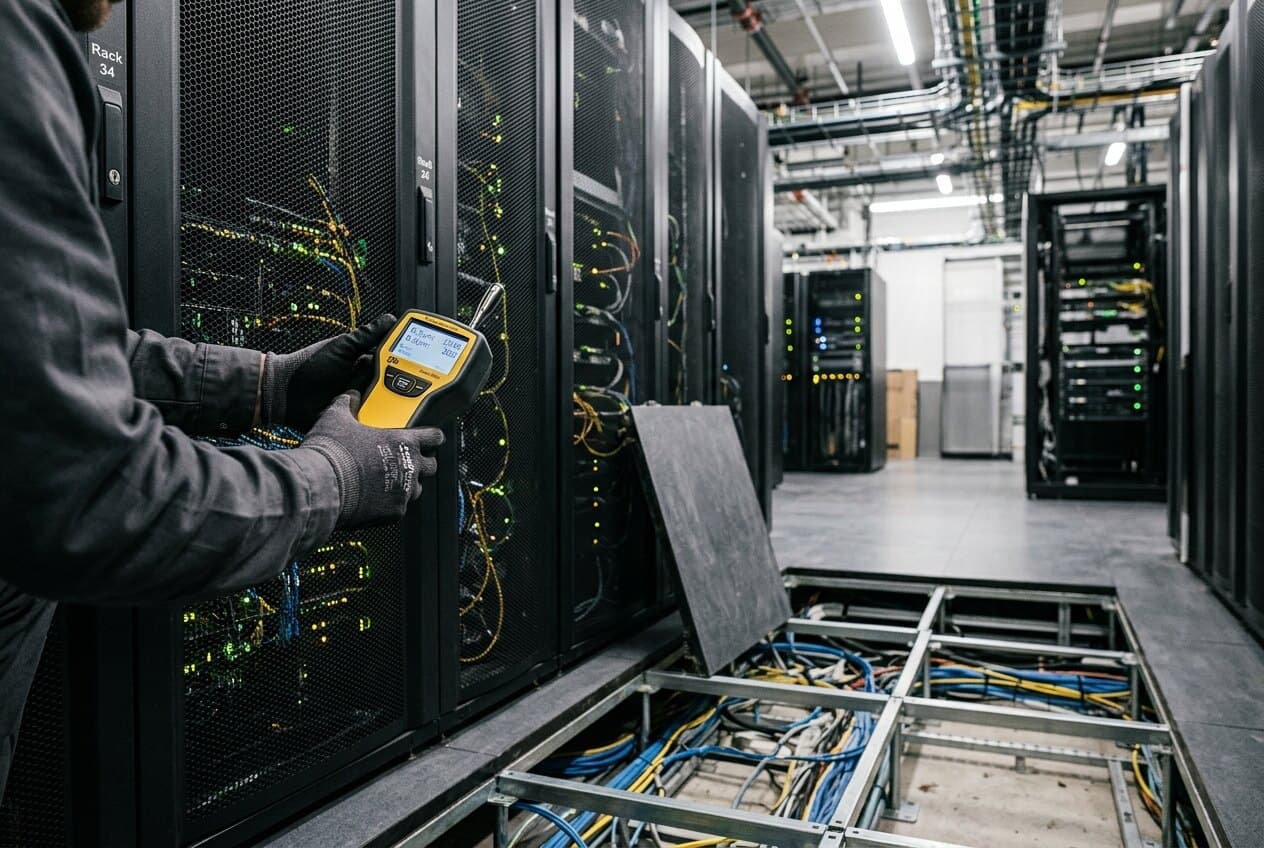
Technical cleaning to protect operational continuity
The service is designed to control contamination and maintain proper conditions in critical environments.
Which risks does it mitigate?
- Dust, debris and particles that can contribute to short circuits, overheating or failures.
- Dirt buildup in the plenum and obstructions that restrict airflow.
- Clutter and contamination that affect the work environment and safety.
Which results does it pursue?
- A cleaner, more controlled technical environment for equipment and staff.
- Better operating and maintenance conditions for the facility.
- Verification through initial and final particle measurements and a photographic report.
Scope of the service
Full coverage of the surfaces and components defined for the technical room or data center.
- 01
Raised floors
Controlled tile lifting; cleaning of the plenum and the tiles.
- 02
Ceilings and walls
HEPA-filtered vacuuming of ledges, light fixtures and ducts.
- 03
Racks and cabinets
Exterior cleaning of surfaces and micro-perforated doors.
- 04
Electrical panels
Included within the scope of the specialized service.
- 05
Windows and entrances
Microfiber, anti-static cleaner and disinfection of entry points.
- 06
General equipment
Peripherals in operations rooms, without working inside the servers.
Execution methodology
Service flow
- Initial measurement
- Deep cleaning
- Final validation
We do not handle the inside of servers or disconnect active cabling.
- 01
Inspection and preparation
Particle baseline, “Before” photo record and protective covers for equipment where applicable.
- 02
Infrastructure cleaning
Ceilings, walls, light fixtures, ducts, windows, glass partitions, doors and entrances.
- 03
Raised floor cleaning
Tile removal by section, debris extraction and HEPA vacuuming of the plenum.
- 04
Racks and exterior hardware
Vacuuming and anti-static cleaning of exteriors; operations room peripherals.
- 05
Completion and validation
Final measurement, comparison, “Before/After” photo report and client sign-off.
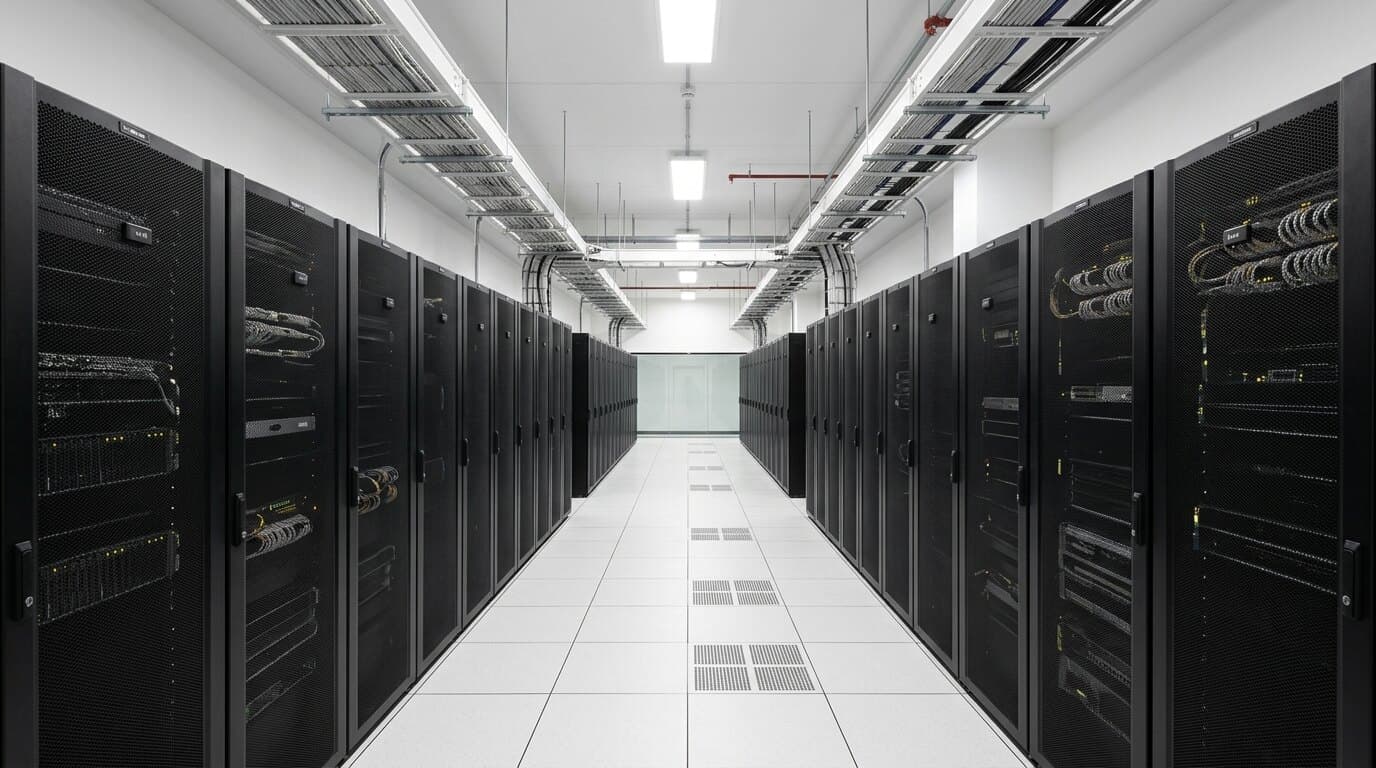
The raised floor: the critical point
The plenum is cleaned section by section to maintain the room's operating conditions.
- 01
Controlled lifting. Tiles are removed by section, in a checkerboard pattern, to maintain underfloor air pressure.
- 02
Debris extraction. Cable offcuts, cable ties, screws and other accumulated solids.
- 03
Deep vacuuming. HEPA-filtered, over the concrete slab and pedestals.
- 04
Trays and cabling. Cleaned with cloths dampened with isopropyl alcohol, followed by dry cloths.
- 05
Tiles. Top and bottom surfaces cleaned with fast-evaporating products.
Measurement and validation of the service
Technical reference: ISO 14644-1 for airborne particle control.
Initial count
Before the service
- Initial particle measurement to establish a baseline.
- Visual record of the room's condition.
- Identification of critical areas and preparation for the work.
Final count
After the service
- New particle count to verify the reduction in contamination.
- Report with particle counter readings and “Before/After” photos.
- Signed service acceptance.
ISO 14644-1 · Class 8 or higher depending on design
Resources, equipment and controls
Personnel and materials suited to critical environments and to protecting electronics.
Personnel
- Specialist supervisor.
- Quality and safety assurance: OHS (occupational health and safety).
- Technicians trained in cleaning critical environments.
Equipment and supplies
- PCE-RCM 10 particle counter.
- HEPA-filtered vacuuming.
- Microfiber cloths and anti-static solutions.
- Isopropyl alcohol for trays and cabling.
- Dielectric, low-particle-shedding supplies.
Operational controls
- Protection of critical equipment when work at height is required.
- Tile lifting by section.
- Photographic evidence log.
- Immediate reporting of infrastructure anomalies.
- No disconnection of active cabling.
Frequently asked questions
Which standard is used to measure data center technical cleaning?
Soluciones Dacast measures airborne particles before and after the service with a PCE-RCM 10 particle counter, using ISO 14644-1 as the technical reference (Class 8 or higher depending on the room's design). The standard is the measurement reference, not a certification.
Do servers have to be shut down or disconnected during cleaning?
No. During Soluciones Dacast's technical cleaning, the inside of the servers is not handled and active cabling is not disconnected. The raised floor is cleaned section by section, lifting tiles in a checkerboard pattern to maintain underfloor air pressure.
How is the cleaning result proven?
With an initial particle measurement as a baseline and a final count on completion, plus a report with the counter readings, “Before/After” photos and a signed service acceptance. In a data center serviced in December 2025, the PM2.5 count fell from 449 to 59 particles per m³ (−86.9%).
How often should technical cleaning be repeated?
In the final report of a completed job, Soluciones Dacast recommended scheduling specialized technical cleaning every 2 to 4 months, based on the measured particle build-up rate, to keep floor dust from being drawn in by the servers' fans.
A specialized solution for critical environments
- Continuity
- Preserve proper operating conditions in the data center.
- Safety
- Reduce the risks associated with contamination and clutter.
- Control
- Measure, document and validate the outcome of the service.
Technical cleaning focused on continuity, safety and environmental control.